How a childhood fascination with hotels, a visit to the Brussels Sheraton and an unexpected piece of career advice shaped my future in hospitality.
Long before DNA Hotels, before the internet and before I even knew that hospitality marketing could be a profession, there were scissors, glue and travel brochures.
As a child, I was fascinated by travel and hotels. I befriended the lady at our local travel agency in Vlissingen, where I would spend Friday afternoons browsing through brochures.
Eventually, I started creating my own handwritten travel guides, cutting out photographs, sticking them onto paper and writing about the hotels I found most interesting.
Come to think of it, not that much has changed.
A Rather Unusual Childhood Hobby
By the age of thirteen, I had collected around 800 hotel brochures from around the world.
I would look up hotel addresses in directories and write letters requesting brochures. Some hotels were remarkably generous. Others never replied. One package from the United States arrived with fifty Dutch guilders’ worth of postage.
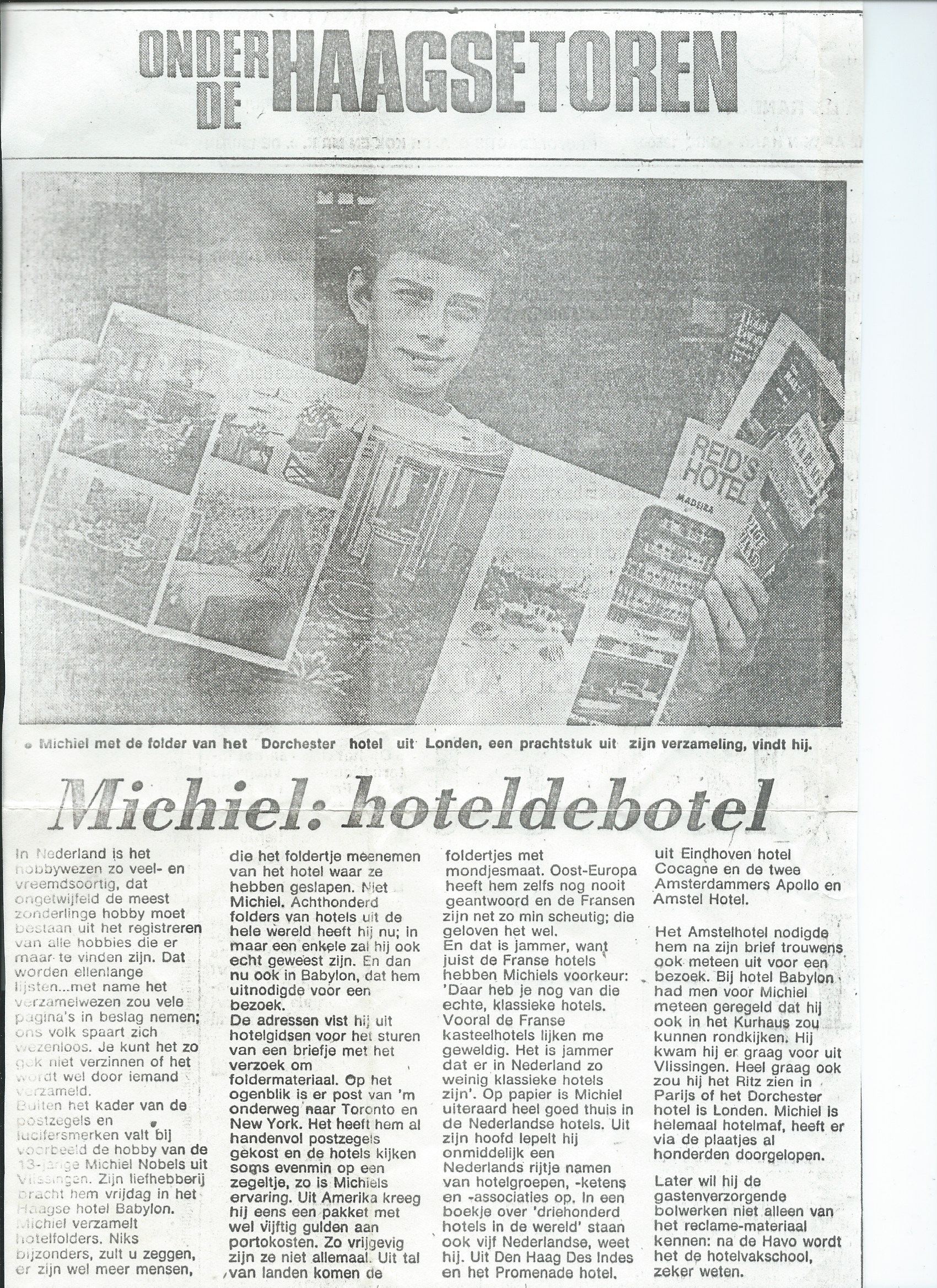
My fascination even attracted the attention of a Dutch newspaper when the Babylon Hotel in The Hague invited me for a visit.
The headline read:
“Michiel: hoteldebotel” — a Dutch play on words suggesting that I was completely crazy about hotels.
The photograph shows me proudly displaying a brochure of The Dorchester in London, one of the treasures of my collection.
Reading the article again decades later, I am struck by how many of my interests were already there: hotel architecture, classical French hotels, the identities of international hotel brands and the individuality of particular properties.
Even on family holidays travelling south towards the Mediterranean, I would write down the names of the hotels I recognised from the motorway.
Novotel! ibis!
Hotel branding fascinated me long before I understood what branding was.
The People Who Opened Their Doors
What I remember most fondly, however, is the generosity of the people I encountered.
The Amstel Hotel in Amsterdam invited me for a tour and offered me lunch. For a young teenager, that was quite an experience.
The Babylon Hotel arranged for me to visit the Kurhaus in Scheveningen as well.
These were hospitality professionals taking the time to share their world with a young boy who happened to be fascinated by hotels.
They had absolutely nothing to gain from it.
Yet their kindness helped shape the direction of my life.
Drive and Elbows
One encounter in particular stayed with me.
During a visit to the Sheraton Hotel in Brussels, I met the sales and marketing manager. Sheraton was still a standalone hotel brand at the time, and I was fascinated by the commercial world behind these international hotels.
I asked her how I could eventually become a sales manager for a major hotel chain.
Her answer was simple:
“Drive and elbows.”
It was the 1980s, after all.
The drive I always had, and still have.
The elbows were never really my thing.
Nevertheless, that conversation helped shift my interest towards the marketing side of hospitality — towards understanding how hotels distinguish themselves, how they communicate their identity and why people choose one hotel over another.
Questions that continue to occupy me today.
From Sheraton to Magritte
I was reminded of that encounter when I learned that the former Brussels Sheraton was being transformed into Cardo Brussels.
The original hotel, a prominent high-rise dating from 1972, had closed in 2016. Its redevelopment gave the building an entirely new hospitality identity.
Today, Cardo Brussels operates as part of Marriott’s Autograph Collection. In an interesting twist of corporate history, Marriott also owns Sheraton.
The building’s exterior now features a monumental interpretation of René Magritte’s famous painting Le Fils de l’homme — The Son of Man.
Where I once remember the distinctive Sheraton branding, there is now an expression of Belgian surrealism.
The same building. An entirely different identity.
Cardo Brussels is now featured on DNA Hotels.

Some Things Never Really Change
My collection of hotel brochures eventually disappeared into the paper recycling bin, several years after the arrival of the internet.
I am a minimalist, after all.
Fortunately, the newspaper clipping survived.
Today, my interests extend beyond discovering hotels to exploring hotel concepts, brand identity, architecture, development and commercial strategy.
But the curiosity behind all of it remains much the same.
Why does one hotel capture our imagination while another leaves us indifferent? What gives a hotel its personality? What makes it worth remembering?
Decades ago, I explored those questions with scissors, glue and handwritten travel guides.
Today, I do so through DNA Hotels and my work in hospitality.
I think that thirteen-year-old would have been rather pleased.