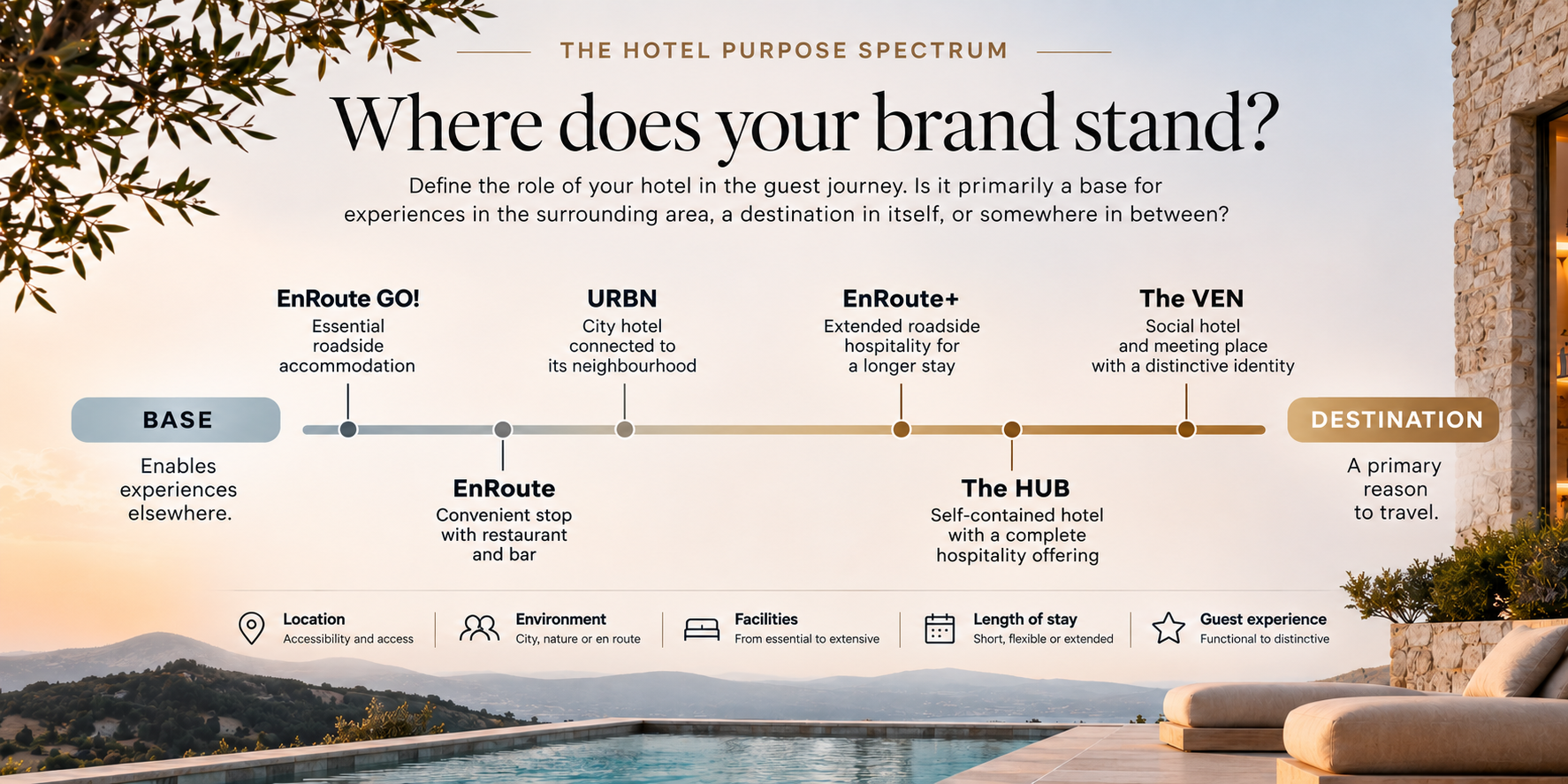
Before defining a hotel brand, designing a building or deciding which facilities to offer, perhaps we should first establish the role the hotel plays in the guest’s journey.
When someone tells me they are staying at a Hilton, I know relatively little about the kind of hotel experience they are about to have.
It could be a city-centre hotel in London, a large convention hotel in the United States, a suburban property beside a motorway, an airport hotel or an all-inclusive resort on a tropical beach.
All are perfectly legitimate hotel products. All can operate successfully under the same brand.
But they serve fundamentally different purposes.
The Hilton name provides a degree of reassurance regarding quality, service standards, reliability and access to a global loyalty programme. It does not necessarily tell me what role the hotel will play in my journey.
And that is a distinction I find increasingly interesting.
Perhaps one of the most fundamental questions in hotel development and branding is also one of the simplest:
Is the hotel a destination or a base?
Two Fundamentally Different Propositions
A hotel functioning as a base enables something else.
It allows guests to explore a city, attend a business meeting, visit family, catch an early flight, continue a journey or spend time at the beach.
Its value is largely determined by what it makes accessible.
A destination hotel, by contrast, is itself a significant reason for travelling.
Its architecture, landscape, restaurants, wellness facilities, social atmosphere or particular approach to hospitality may be what motivates the guest to make the journey in the first place.
Its value is largely determined by what happens within and around the property itself.
Neither proposition is inherently superior.
A beautifully designed city hotel with compact guestrooms and very few facilities can be an exceptional hospitality product. So can an extensive resort where guests rarely feel the need to leave the property.
The problem arises when a hotel is developed, operated or marketed without a clear understanding of which proposition it is intended to deliver.
A Spectrum Rather Than a Binary Choice
Of course, not every hotel fits neatly into one of these two categories.
A historic grand hotel may be both a destination in its own right and an excellent base from which to explore a city.
A convention hotel may be the destination for someone attending a conference, but simply a convenient place to sleep for another guest.
A roadside hotel with an excellent restaurant may attract local visitors while primarily serving travellers passing through.
The distinction is therefore better understood as a spectrum.
At one end is the hotel that exists primarily to facilitate activities elsewhere. At the other is the hotel around which the entire stay is organised.
Between these extremes lies a wide range of hospitality products.
What matters is understanding where a property predominantly sits on that spectrum — and whether its facilities, operations and identity support that position.
The Economics of Being a Base
If a hotel primarily functions as a base, why should it necessarily provide everything its guests might need within its own walls?
Consider a small city hotel surrounded by excellent cafés, restaurants, bars, cultural institutions and independent shops.
The neighbourhood effectively becomes an extension of the hotel.
Investing heavily in a conventional restaurant, extensive public spaces or large guestrooms may not always represent the best use of capital.
The same principle applies to roadside hotels.
A comfortable bed, a good shower, convenient parking, reliable connectivity and a straightforward breakfast offering may be considerably more relevant than a comprehensive range of hotel facilities.
Its location, compact guestrooms and surrounding commercial infrastructure suggest that a more focused hotel product could be entirely appropriate.
The objective is not to provide less for the sake of reducing costs.
It is to invest in the things that matter most to the guest, rather than duplicating facilities that are already available nearby.
A hotel functioning as a base can still have a strong identity, thoughtful design and a memorable atmosphere.
Being functional does not mean being generic.
The Economics of Being a Destination
A destination hotel operates according to a different logic.
Here, the facilities are often not supplementary services. They are integral to the reason guests choose the property.
A secluded rural retreat without a compelling food and beverage offering may struggle to deliver a complete experience.
A resort without attractive communal spaces, recreational facilities or meaningful outdoor areas may fail to justify its location.
A hotel positioning itself as a social destination needs to invest in spaces that encourage people to gather and spend time.
The guestroom is only one component of a much broader hospitality product.
This has implications not only for development costs but also for revenue generation, staffing, operational complexity and the relationship between accommodation and ancillary spending.
Where a hotel functioning as a base can benefit from outsourcing parts of the guest experience to its surroundings, a destination hotel often needs to internalise more of that experience.
The economics are fundamentally different.
What Does a Hotel Brand Actually Promise?
The evolution of the major international hotel groups raises an interesting question about the meaning of hotel brands.
Many established brands now encompass an extraordinarily diverse range of properties.
A single brand can include urban hotels, airport hotels, convention centres, suburban properties and leisure resorts.
From a commercial perspective, this is understandable. Brand recognition, distribution infrastructure, loyalty programmes and operational standards can create value across multiple hotel categories.
But from a product perspective, the brand may become less precise.
It tells the guest something about the expected standard of hospitality, but relatively little about the nature or purpose of the stay.
There is a difference between a quality promise and a product promise.
A quality promise provides reassurance about how well something will be delivered.
A product promise explains what will actually be delivered and why it is relevant to the guest.
This distinction also touches on a subject I explored in my article You Can’t Sleep in a Brand. Ultimately, guests do not experience a brand in the abstract. They experience a physical hotel, its spaces, its atmosphere, its facilities and its relationship with its surroundings. A brand should help guests understand that experience before they arrive, rather than merely reassure them about its quality.
The strongest hotel brands can combine both.
This does not necessarily require architectural uniformity or identical facilities across every property. But it does require a recognisable underlying proposition.
Perhaps the starting point for developing a hotel brand should not be its star classification, price segment or interior design style.
Perhaps it should be the role the hotel is intended to play in the guest’s journey.
Four Brands, Six Expressions of Hospitality
This distinction has become increasingly important in the development of my own hotel brand concepts.
Although these concepts share an interest in identity, thoughtful design and operational relevance, they approach the relationship between hotel and guest in different ways.
EnRoute
EnRoute is primarily about facilitating a journey. Accessible locations, convenient parking, comfortable accommodation and straightforward hospitality form the basis of the proposition.
Within the brand, three different formats respond to different locations, market conditions and guest requirements.
EnRoute GO! represents the most focused expression of roadside hospitality. Compact guestrooms, a coffee and breakfast bar and an uncomplicated arrival experience provide the essentials without unnecessary operational complexity.
EnRoute offers a more complete roadside hotel experience, including a restaurant and bar, providing guests with greater convenience without fundamentally changing the purpose of the hotel.
EnRoute+ moves further towards the destination end of the spectrum. A broader range of facilities, more extensive public spaces and opportunities for relaxation make the hotel more than simply a convenient stop along the way.
In this respect, EnRoute+ occupies a position similar to The HUB, although its identity remains rooted in roadside hospitality and the journey itself.
The three formats illustrate how a single hotel brand can accommodate different levels of service and facilities while retaining a coherent underlying product identity.
URBN
URBN explores compact city hotels that draw much of their character and value from their neighbourhoods.
The surrounding city provides many of the experiences that might otherwise need to be created within the hotel.
The property becomes a thoughtfully designed base for urban exploration.
Its identity is inseparable from its relationship with the neighbourhood.
The HUB
The HUB occupies a different position on the spectrum.
It explores hotels in suburban and less central locations where a more complete range of facilities can make the property attractive despite its distance from traditional urban centres.
Restaurants, meeting spaces, leisure facilities and comfortable communal areas create a more self-contained hospitality experience.
Guests do not necessarily need to leave the hotel to find what they are looking for.
The VEN
The VEN explores the potential of larger hotels as social destinations.
Rather than treating extensive public areas simply as supporting infrastructure for guestrooms, the concept considers them central to the hotel’s identity.
The hotel becomes a place where people meet, work, eat, drink and interact, while the guestrooms offer a more private retreat.
Its relevance can extend beyond overnight guests to the wider community.
These four concepts are not simply different design styles or price categories.
They represent different answers to the question of what a hotel is for.
Start With Purpose, Not Facilities
Traditional hotel development often begins with a familiar set of questions.
How many rooms can the building accommodate? Which star classification should the hotel target? Does it need a restaurant? How large should the lobby be? Which brand might be suitable?
These are all relevant questions.
But their answers should ideally follow from a more fundamental understanding of the hotel’s purpose.
A restaurant should not be included simply because hotels in a particular category are expected to have one.
A large lobby should not be created merely because it looks impressive on architectural drawings.
Guestrooms should not automatically become larger because the hotel is moving into a higher price segment.
Each investment should contribute to the proposition the hotel is intended to deliver.
This is particularly relevant when considering hotel development and repositioning within existing buildings.
Rather than imposing a predetermined hotel model on a property, it may be more productive to examine what the building, its location and its surroundings naturally lend themselves to.
The brand should emerge from that understanding.
Why This Matters in the Age of AI
As hotel discovery becomes increasingly driven by natural-language requests, the distinction between a destination and a base may also become more relevant to distribution.
A traveller looking for somewhere comfortable to sleep while exploring Rome has fundamentally different requirements from someone looking for a hotel in which to spend a restorative weekend.
Both may have the same budget. Both may appreciate architecture and design. Both may be searching within the same geographical area.
But they are looking for different hospitality products.
Conventional hotel classifications do not always make that distinction sufficiently clear.
As I explored in Location, Location, Location — Is That Still a Thing in the Age of AI?, the relationship between a hotel and its surroundings is an important part of understanding its identity.
A clearer understanding of the hotel’s purpose could help both travellers and emerging discovery technologies establish whether a property is appropriate for a particular stay.
This is not simply a marketing opportunity.
It begins with product development.
Not Every Hotel Needs to Be a Destination
There has been a tendency in contemporary hospitality to suggest that every hotel should become an experience, a lifestyle destination or a place where guests want to spend more time.
I am not convinced.
Sometimes the most valuable thing a hotel can do is enable guests to experience something else.
A city. A landscape. A neighbourhood. A business opportunity. A journey.
Other hotels should do precisely the opposite: give guests compelling reasons to stay, explore the property and make the hotel itself part of the purpose of travelling.
Both approaches can produce exceptional hospitality.
Both can support distinctive brands and commercially successful operations.
The challenge is not to make every hotel more experiential, more luxurious or more comprehensive.
It is to understand which experience the hotel should provide.